Foundations Built on Properly Excavated Sites
Residential Excavation in Dawsonville for new home construction, basement additions, or utility installations requiring precise depth control
Accurate excavation determines whether foundations settle evenly or develop cracks within the first five years. Grading & Clearing Services excavates building sites using GPS-guided equipment that maintains depth tolerances within two inches across the entire foundation footprint. Residential excavation in Dawsonville accounts for clay soil expansion, seasonal water table fluctuations, and bedrock depth variations that affect footing placement and drainage system design.
The process begins with marking foundation corners using survey stakes, excavating to specified depth while separating topsoil for later redistribution, and shaping subgrade to match engineered slope requirements for drainage. Operators verify depth using laser levels before concrete contractors arrive, and trenches for utility lines are cut simultaneously to minimize repeated excavation across the building pad.
Request a free quote for residential excavation services including foundation preparation, utility trenching, and finish grading coordination.
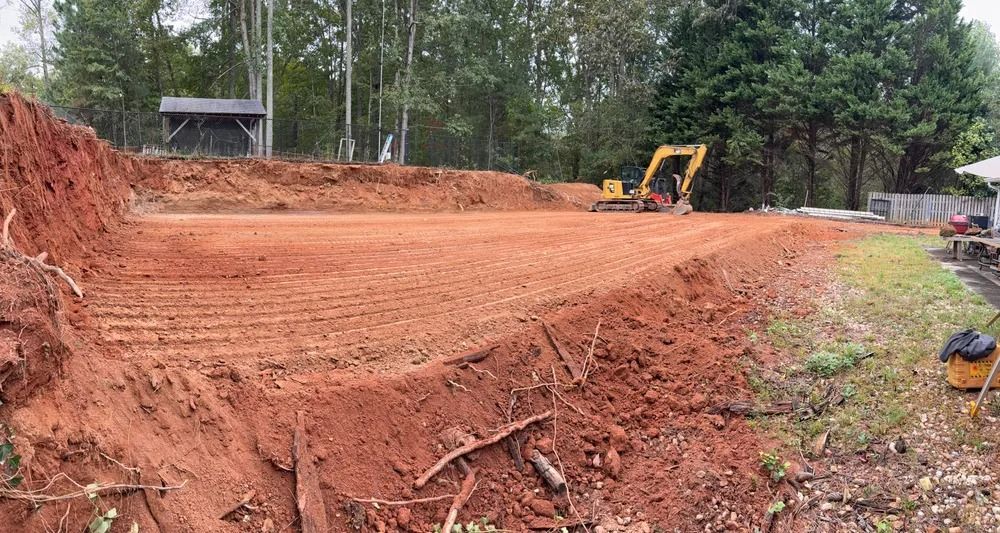
What You Notice Once Excavation Is Finished
Residential excavation involves removing soil in controlled lifts rather than single-pass digging, which prevents over-excavation and maintains stable sidewalls for foundation forms. Equipment operators compact subgrade in incremental layers when fill material is required, ensuring uniform bearing capacity across the entire pad. Utility trenches are sloped according to code requirements for sewer and drainage lines, and excavated soil is stockpiled on-site for backfill or grading phases that follow foundation curing.
Once excavation is complete, you see foundation corners that match architectural plans within inches, level subgrade ready for concrete placement, and trenches positioned for plumbing and electrical rough-ins. Water no longer pools in low spots across the pad, and soil compaction supports heavy construction traffic without rutting. Foundation contractors can begin forming and pouring without waiting for additional grading or correction work.
Excavation depth and complexity vary based on whether homes require full basements, crawl spaces, or slab-on-grade foundations. Sites with significant slope may require retaining wall footings or terraced excavation to create level building areas. Grading & Clearing Services adjusts excavation methods when encountering rock layers that require hydraulic hammers or blasting, and coordinates soil testing when engineers specify compaction density for expansive clay conditions common throughout north Georgia.
Common Questions About This Service
Homeowners planning new construction or additions in Dawsonville typically ask about excavation accuracy, soil conditions, and project coordination before breaking ground.
How is excavation depth verified before concrete placement?
Operators use rotating laser levels mounted on tripods to confirm subgrade elevation matches foundation plans, with measurements taken at multiple points across the pad to ensure uniform depth.
What happens if bedrock is encountered during excavation?
Shallow bedrock requires hydraulic hammer attachment to fracture stone to specified depth, or engineered foundation design adjustments to accommodate reduced excavation depth depending on structural load requirements.
When should excavation be scheduled relative to weather conditions?
Excavation should occur during extended dry periods when possible, as wet clay soil becomes unworkable and equipment creates compaction issues that affect long-term foundation stability.
How does Georgia clay soil affect foundation excavation?
Clay expands when wet and contracts during dry periods, requiring foundation designs that account for seasonal soil movement and drainage systems that prevent water accumulation against basement walls.
What site access is required for excavation equipment?
Excavators and dump trucks require at least twelve-foot-wide access routes with overhead clearance of fourteen feet and turn radius sufficient for articulated vehicles to maneuver without damaging landscaping or adjacent structures.
Grading & Clearing Services completes residential excavation projects throughout north Georgia using equipment calibrated for accurate depth control and soil conditions specific to each building site. Schedule a consultation to review foundation plans, site access, and soil testing results before excavation mobilization.